For emergency, on-call & out-of-network surgeons and practices.

Insurance carriers
may owe your practice
six figures. Really.
Out-of-network emergency claims are routinely paid at 3 to 10% of billed charges. Federal arbitration recovers 75 to 85% on average, and a free claims exposure review shows you exactly what your claims are worth.
94%
average win rate
in arbitration
$0
upfront, filing costs fronted

Official arbitration partner of multiple state medical associations
Official arbitration partner of multiple
state medical associations
94%
average win rate
in arbitration
$0
upfront, filing costs fronted
Official arbitration partner of multiple state medical associations
Official arbitration partner of multiple
state medical associations
WHAT ARE YOU LEAVING WITH THE CARRIERS?
See what your claims may be worth

$100M+
recovered per month

94%
average win rate

$0
upfront cost

75 to 85%
of billed charges recovered
why you’re underpaid:
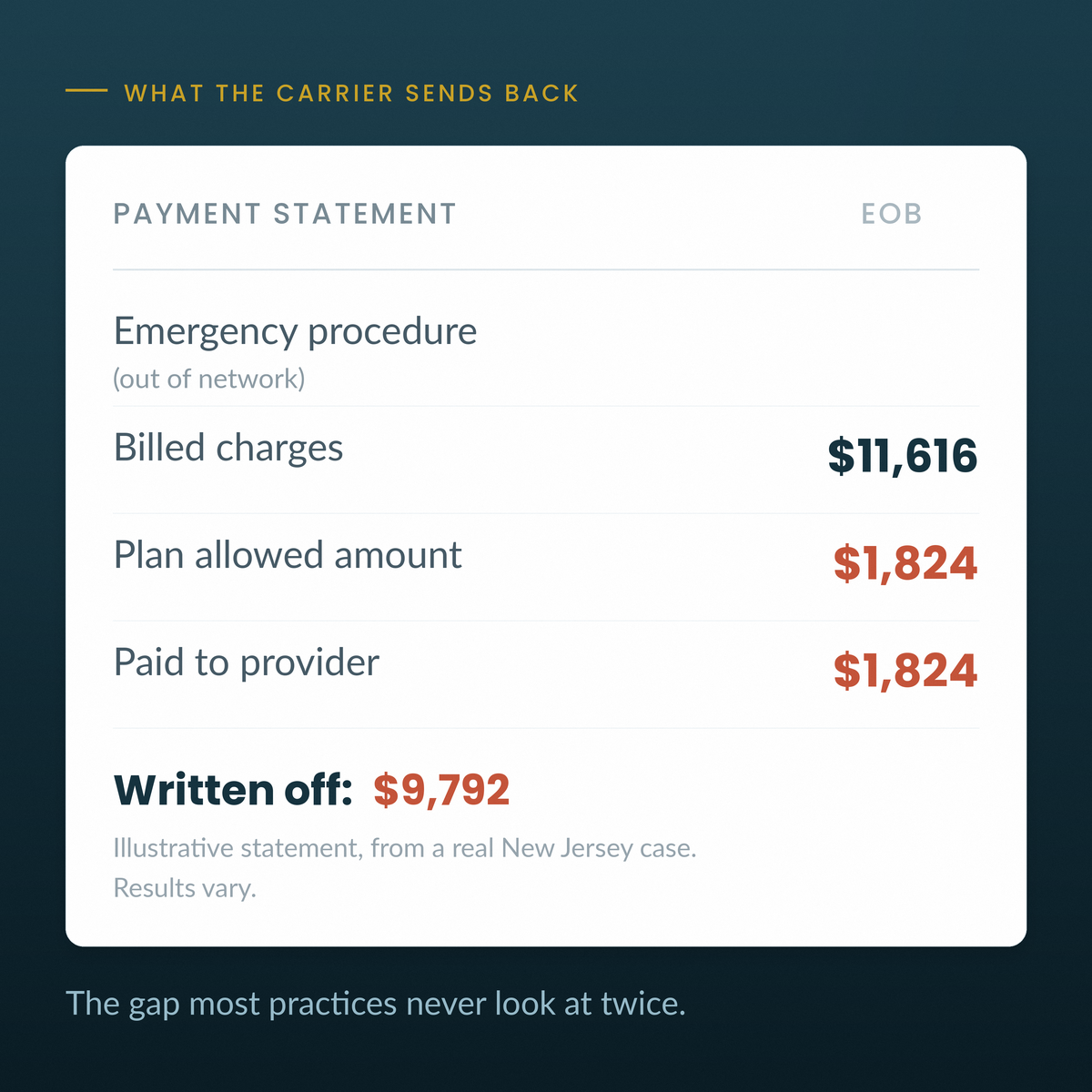
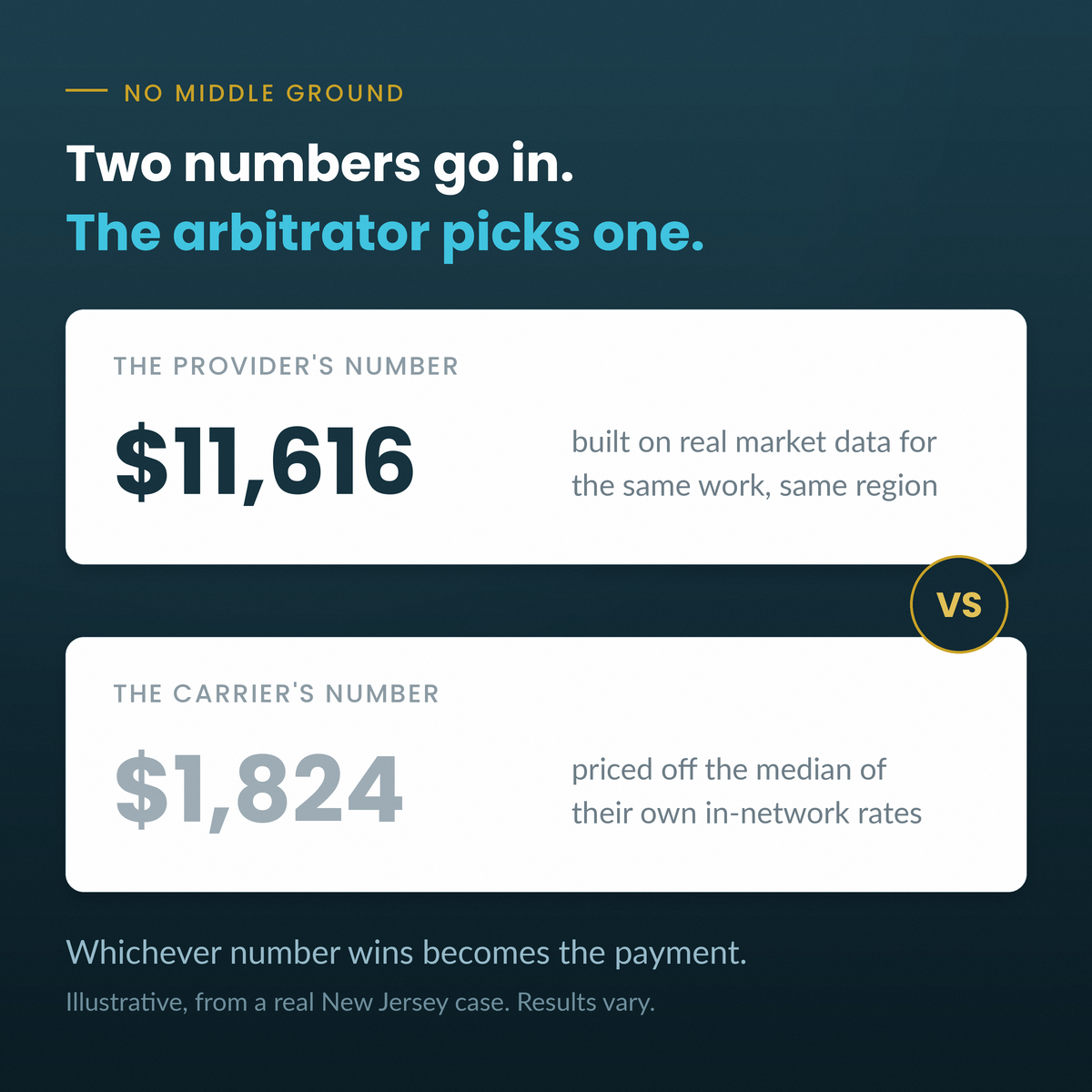
When you treat a patient out of network, the carrier prices the claim off the qualifying payment amount, the median of their own in-network rates. They pick the benchmark and they own the data, which is why payments routinely arrive at 3 to 10% of billed charges. It isn't an accounting error, it's a pricing decision you never agreed to.
what changed:
The No Surprises Act created a federal arbitration process for exactly this situation. You submit a number, the carrier submits a number, and a neutral arbitrator must pick one, with no splitting the difference. Built correctly, with real market data behind it, the provider's number wins 94% of the time, and typical recoveries run 75 to 85% of billed charges, 10 to 12 times the underpayment.
why now:
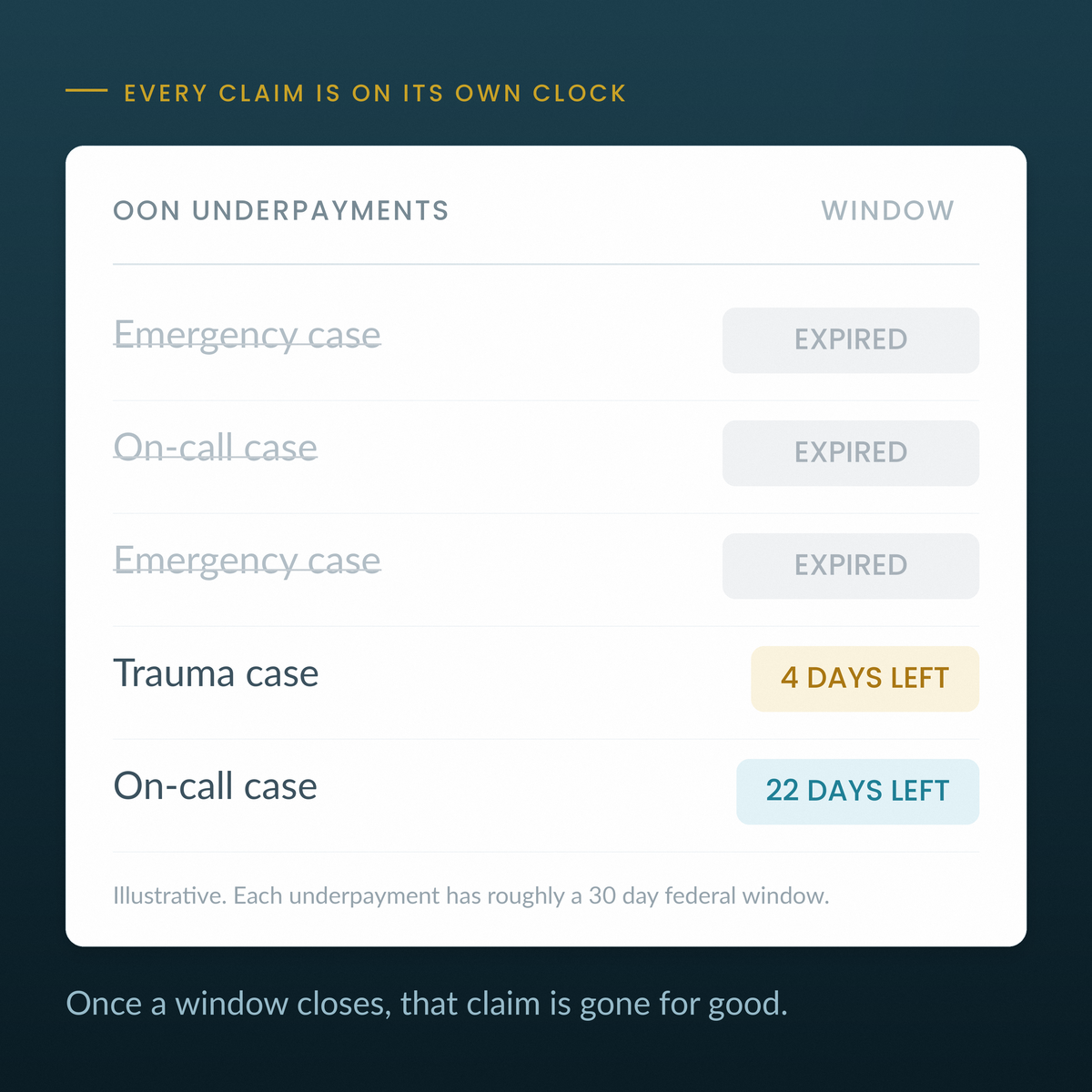
Roughly 90% of eligible claims expire unfiled, about $500 billion a year that stays with the carriers, because the window to act on each underpayment is only about 30 days. For a practice seeing even a handful of eligible cases a month, that can mean six figures a year quietly expiring. The work is already done, and the only question is whether you collect it.
Real client data
NJ oral surgery group

Billed
$11,616

Carrier paid
$1,824

Arbitration awarded
$9,793
84% of billed charges

Across 29 files
$283,992
recovered.
Billed
$11,616
Carrier paid
$1,824
Arbitration awarded
$9,793
84% of billed charges
Across 29 files
$283,992
recovered.

It’s a free 20 to 30 minute call that gives you a detailed
read on your claims.
WHO THIS IS FOR
Surgeons and specialists taking emergency call.
Practice owners and administrators.
Inadvertent providers at in-network facilities (anesthesia, assistant surgeons, IONM, radiology, oral & maxillofacial).
Billing and RCM companies: we partner with dozens; ask about the partnership track.

Our Medical Partners





HOW IT WORKS

Easily share your files
A HIPAA BAA first, then send EOBs however your office prefers.

We handle everything
Deadlines, filings, fees, arbitration, and enforcement.

You get paid first
The carrier pays you directly, then we invoice our fee, about 20% on average, only on money recovered.
Frequently Asked
Questions
Because I did the work and deserve to be paid fairly for it.
How does this actually work?
You sign a HIPAA BAA, easily share your out-of-network EOBs, and we handle the rest: eligibility, deadlines, filings, arbitration, and collection. The carrier pays you directly, and we invoice only after your money lands.
What do you charge?
A contingency of about 20% on average, charged only on the additional money we recover. If a case loses or we recover nothing, you owe nothing, and we front the filing costs on every file, period.
Is this a legal process? Do I need a law firm?
No. Federal IDR arbitration isn't a lawsuit and doesn't require one. Callagy Recovery was born from Callagy Law, and if a carrier refuses to pay an award, enforcement can escalate through Callagy Law. The arbitration itself is handled end to end by our recovery team.
What’s your win rate?
94% on average in arbitration, in all states, for all specialties, against all carriers.
How long until I’m paid?
75% of awards are paid within 7 months, and 93% within 12. After your first cases resolve, recoveries tend to arrive monthly because new filings have been running behind them.
I already have a billing company
Keep them. We're not a billing company or an RCM, and we never collect from patients. We handle only the arbitration piece most billing teams aren't built for, and we partner with dozens of billing and RCM companies.
What qualifies?
Out-of-network emergency and on-call work, and inadvertent services at in-network facilities, billed to commercial insurance. Medicare, Medicaid, TRICARE, and VA don't qualify, the carrier must have paid something, and underpayments (not denials) are the target.
How long do I actually have?
On the federal side, roughly 30 business days from the EOB to open negotiation, with tighter windows later in the process. Some states allow longer (New York, for example, allows up to three years). Tracking every one of those clocks is the first thing we take off your plate.
Can I leave?
Anytime. Month to month, no long-term contracts. Cases already in arbitration run to completion and you still receive those awards.
Callagy Recovery is an arbitration services company, not a law firm, and does not engage in patient collections. Individual results vary and no outcome is guaranteed.
Copyright © 2026 Callagy Recovery Corporation. All rights reserved.